One Machine, First Payout: Counting Down to 0.001 BTC
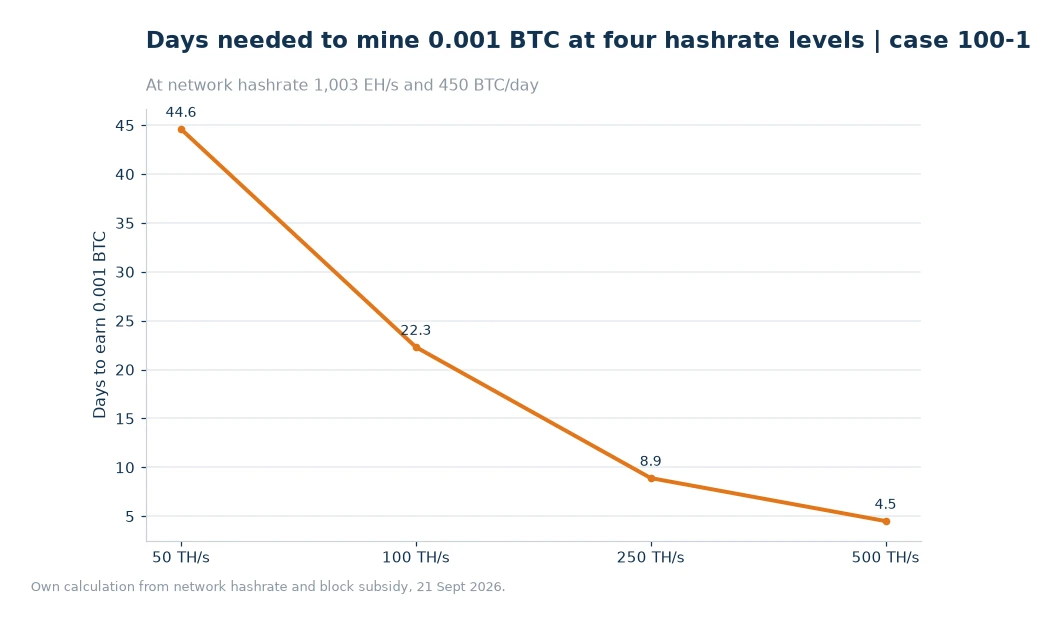
A modest 50 TH/s box earns about 0.00002243 BTC a day, so the first 0.001 BTC lands after 44.6 days; a 500 TH/s shelf reaches the same mark in 4.5 days. Those two waits frame the beginner experience at current difficulty of 132.76 T. This guide explains the countdown, the hourly rhythm behind it and how to confirm nothing is stuck.
Key takeaways
- At 50 TH/s the daily rate is 0.00002243 BTC, so 0.001 BTC needs 44.6 days.
- At 500 TH/s the same 0.001 BTC needs 4.5 days, with 250 TH/s landing at 8.9 days.
- Each terahash earns about 0.0000004487 BTC a day from the 450 BTC network pool.
- PPS+ posts credits hourly; PPLNS releases them after 6 confirmations over the last 5 difficulty rounds.
What a single unit actually contributes
One small machine looks negligible next to a network near 1,003 EH/s, yet its contribution is perfectly measurable: 50 TH/s is fifty out of 1,003,000,000 terahash units sharing 450 BTC a day. The product of that fraction is 0.00002243 BTC daily, a thin but utterly predictable stream. Predictability is the beginner's friend; nothing here depends on luck at the miner's own scale.
Set expectations in weeks, not evenings. The first week at 50 TH/s accumulates roughly 0.000157 BTC, a number that looks like dust until you annualize the habit. Mining rewards patience in the same units it rewards scale, and the small rig teaches the accounting that a large one later depends on.
Small numbers obey the same formula
The network pays 144 blocks a day at 3.125 BTC each, and difficulty at 132.76 T only sets the cost of each coin, never the daily total. Divide your terahash by 1,003,000,000 and multiply by 450 BTC: that is your gross daily line at any size. At 100 TH/s it gives 0.00004487 BTC; at 250 TH/s, 0.00011215 BTC. No separate beginner formula exists, which is reassuring rather than disappointing.
Pool-level views then add context without changing the line. Pool Hashrate shows the scale of the operation your shares join, and Pool Luck records whether recent blocks ran hot or cold around expectation. A newcomer watching both for a week learns the difference between signal and noise before any real money is at stake.
Learning to read the hourly credit line
Under PPS+, the block-reward component settles every hour against current difficulty, so the account history fills with small regular entries. Divide the expected daily rate by 24 to know each tick's size: at 50 TH/s that is about 0.000000935 BTC an hour. Watching three or four consecutive ticks match that size is the fastest proof the worker is configured correctly.
The alternative timing, PPLNS, holds payment until 6 confirmations and weights shares across the last 5 difficulty rounds. Its entries arrive in clumps rather than ticks, which unsettles beginners even when the totals match. Either mode reaches the 0.001 BTC mark; only the shape of the journey differs. The ViaBTC Pool Hashrate page helps confirm the worker side is healthy while either cadence plays out.
From forty-four days to four: what each step up buys
The table below converts four starter sizes into calendar waits for the same first milestone. Moving from 50 to 100 TH/s halves the countdown from 44.6 to 22.3 days; reaching 250 TH/s cuts it to 8.9; a 500 TH/s shelf finishes in 4.5. Beside each wait sits the first week's accumulation, the number a beginner actually watches grow.
| Setup | Hashrate | BTC per day | Days to 0.001 BTC | First week BTC |
|---|---|---|---|---|
| Single small box | 50 TH/s | 0.00002243 | 44.6 | 0.000157 |
| Single full unit | 100 TH/s | 0.00004487 | 22.3 | 0.000314 |
| Two units | 250 TH/s | 0.00011215 | 8.9 | 0.000785 |
| Small shelf | 500 TH/s | 0.00022433 | 4.5 | 0.001570 |
Notice the last row clears the milestone inside its first week. That threshold — a setup whose weekly output exceeds the payout interest — is psychologically the moment mining stops feeling theoretical. Anyone choosing between the rows should weigh that feeling honestly; motivation has a price, and the table states it in days.
The waiting period explained without jargon
Between the first share and the first milestone, three things happen in sequence. Shares accumulate continuously as the machine hashes. The pool converts them to BTC credits on its schedule — hourly under PPS+, or after confirmations under PPLNS. Then the balance sits until it passes whatever withdrawal threshold the account sets, moving out afterward with zero-fee mining payouts. Nothing in that chain requires attention most days, which beginners often misread as something being wrong.
Difficulty adjustments punctuate the wait. The September estimate pointed to −2.12%, a small downward move that would shorten every countdown slightly. Adjustments in the other direction stretch them. Either way the table's day counts assume the current 132.76 T holds throughout, so treat them as central estimates with a few percent of weather on either side.
Setting up alerts so the countdown never stalls
A silent machine earns nothing, and a beginner's rig usually fails silently — a tripped breaker, a dropped network cable, a fan fault at 2 a.m. The ViaBTC App for iOS and Android watches reported hashrate and raises a flag when a worker goes quiet, which turns a week-long outage into an evening's fix. Install it on day one and set the threshold near your worker's normal rate.
Pair the app with a weekly glance at the pool's Statistics pages, where pool and network totals frame your worker's line. If your 100 TH/s reports 100 TH/s locally and near that remotely while credits match 0.00004487 BTC a day, everything downstream is just waiting. Check the app download page for the current release and the Statistics overview for the network context behind each reading.
Worked example
Rebuild the 50 TH/s row from the network totals.
- Daily network pool: 144 blocks × 3.125 BTC = 450 BTC.
- Network total: 1,003 EH/s = 1,003,000,000 TH/s.
- Daily BTC per TH/s: 450 ÷ 1,003,000,000 = 0.0000004487 (about 4.5e-07).
- At 50 TH/s: 50 × 0.0000004487 = 0.00002243 BTC a day (2.243e-05).
- Days to 0.001 BTC: 0.001 ÷ 0.00002243 = 44.6 days.
- At 100 TH/s: 0.00004487 BTC a day, so 0.001 ÷ 0.00004487 = 22.3 days.
- At 250 TH/s: 0.00011215 BTC a day, so 0.001 ÷ 0.00011215 = 8.9 days.
- At 500 TH/s: 0.00022433 BTC a day, so 0.001 ÷ 0.00022433 = 4.5 days.
Frequently asked questions
How long until my 50 TH/s box mines 0.001 BTC?
About 44.6 days at current difficulty, since 50 TH/s earns 0.00002243 BTC a day and 0.001 divided by that daily rate gives 44.6.
Why do credits arrive hourly on one mode and in clumps on the other?
PPS+ settles the block-reward component hourly against current difficulty, while PPLNS releases payment after 6 confirmations with shares weighted over the last 5 difficulty rounds, so its entries bunch together by design.
How do I know my worker is healthy during the wait?
Compare three numbers weekly: the machine's local hashrate, the Pool Hashrate view for your worker and the credited BTC against 0.0000004487 per TH/s per day; agreement across all three means the countdown is real.
Start the countdown, then guard it
Pick the row that fits your patience, configure the worker, verify the first hourly ticks and set an alert for silence. The rest is calendar time plus power bills. A 44.6-day wait feels long only in the first week; by the third, checking the balance becomes a pleasant routine rather than an anxious one.
When the balance finally crosses 0.001 BTC, do the division once more at the fresh difficulty before deciding what comes next. If the rate held, the second milestone costs the same wait — and by then you will know exactly how much attention that wait requires, which is close to none.
Sources: the ViaBTC pool state page for worker hashrate display and the fee pages for hourly and confirmation-based settlement[1]. Chain inputs read 21 Sept 2026: network hashrate 1,003 EH/s, difficulty 132.76 T, subsidy 3.125 BTC per block, 144 blocks a day, BTC $84,692. Published 11 Nov 2026; day counts are arithmetic on those inputs and assume continuous uptime.