Body Care Line Lead Times: How to Evaluate Suppliers Before You Commit
A private label body care line rarely ships as fast as the first sales call suggests, because the fragrance is only one of several queues the factory manages. The honest expectation is that packaging, filling and documentation take longer than scent development, and a quoted total that does not say so has not been fully scoped. The way to evaluate a supplier on lead time is to decompose the total into its parts and test each part with one question. Do that before the deposit and the timeline stops being a black box.
Key takeaways
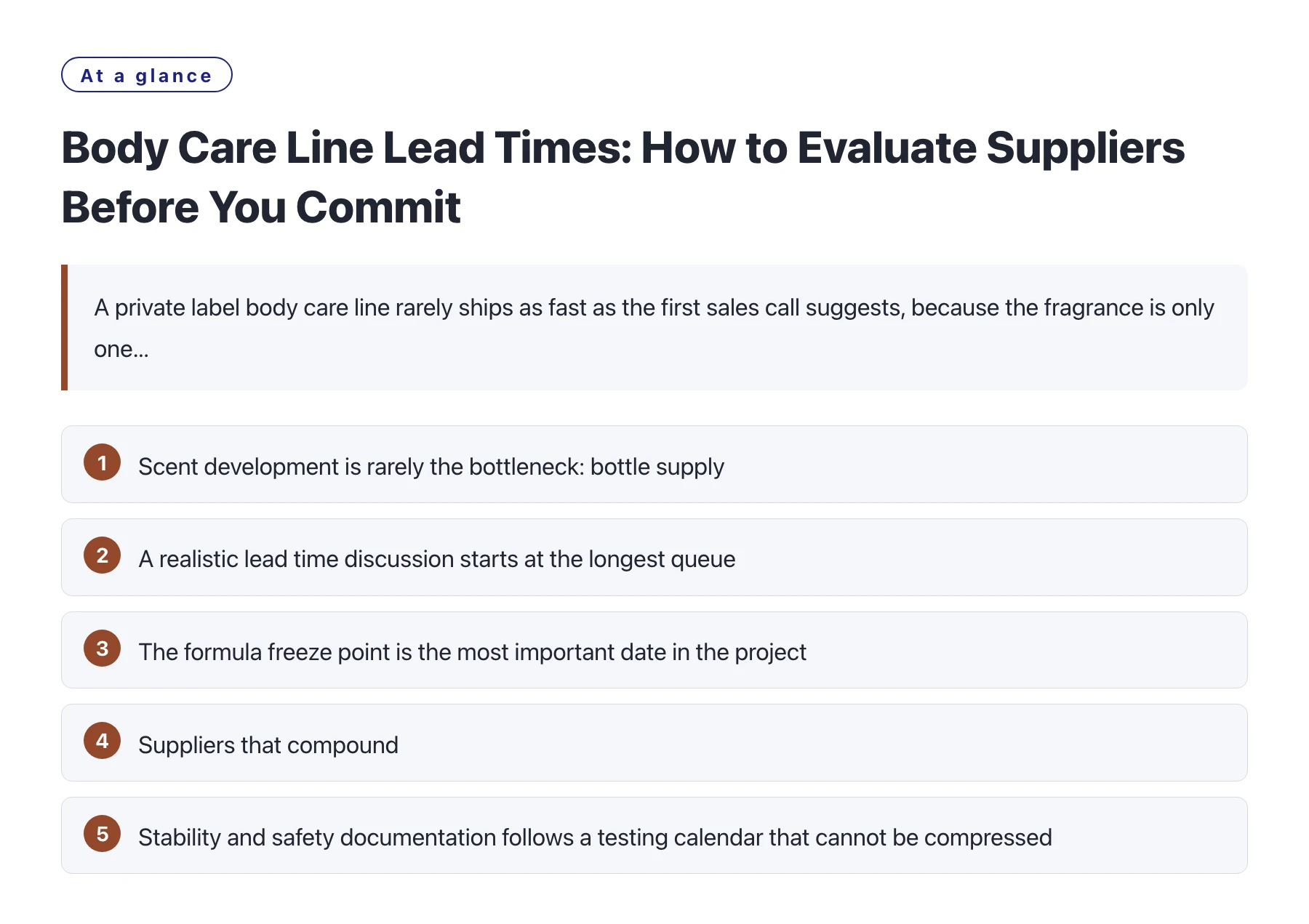
- Scent development is rarely the bottleneck: bottle supply, decoration and filling slots usually set the calendar.
- A realistic lead time discussion starts at the longest queue, not the sum of the work, because parallel streams finish with the last one.
- The formula freeze point is the most important date in the project; changes after the first bulk run reset the testing calendar.
- Suppliers that compound, fill and decorate under one roof remove hand-off delays and answer scope questions in a single list.
- Stability and safety documentation follows a testing calendar that cannot be compressed, so the ship date is set by the laboratory, not the launch plan.
Most buyers ask for a price first and a date second, and both answers arrive with a disclaimer. That is not necessarily dishonesty — it is a reflection of how little has actually been decided. A body care line is a packaging project as much as a fragrance project, and every open decision adds weeks to the end of the calendar.
This article is for buyers at the quotation stage. It maps where the weeks go, what a credible supplier reveals when you ask the right questions, and which parts of the timeline you can compress safely.
None of this requires trusting a supplier's word. It requires comparing the answers you get against a fixed set of checks.
Where the weeks actually go
In rough terms, a body care line from locked formula to shippable carton tends to take about a quarter of a year, and most of that time is packaging. The formula itself may be settled in a few rounds of sampling, but the bottle, the pump, the label and the carton each carry their own supplier lead times, and they run in parallel with the scent work.
The scent queue
Scent development is the shortest queue for a body care product that reuses a proven base; when a supplier offers white label fragrance manufacturing, the perfume is often already blended and stabilised. A bespoke scent adds sampling rounds but rarely changes the total by more than a few weeks, because the perfumer's calendar is short compared to the pack calendar.
The packaging queue
The bottle is usually the real calendar. Moulded containers are produced to order, and a first-time buyer who wants a custom mould should add tooling time on top. Decoration runs on scheduled lines behind larger orders, which is where quoted lead times quietly diverge from realistic ones.
The testing and documentation queue
Scented body care is treated as a cosmetic in most regulated markets, which means the product information file, stability data and microbiology results are deliverables rather than options [1]. Their scheduling belongs to the laboratory, not the sales team, and no amount of persuasion moves a stability time point.
Reading a quoted lead time
| Stage | What happens | What usually stretches it |
|---|---|---|
| Scent development | Brief, briefings, samples, matching | Changes after approval; slow feedback loops |
| Packaging sourcing | Bottle, pump, cap, label and carton orders | Custom moulds; decoration slots |
| Filling and assembly | Blending the batch, filling, capping, labelling | Microbiology release; machine capacity |
| Testing and files | Stability, microbiological, IFRA and market files | Fixed time points; missing ingredient data |
| Shipping | Booking, customs, destination checks | Documentation errors; holiday windows |
Add the rows pessimistically rather than optimistically. The row that is missing from the quote is the one that will add the weeks.
The questions that separate a realistic quote
The fastest filter is scope. Ask which steps the supplier performs in house and which it subcontracts, and ask for the answer as one list. A manufacturer that publishes their OEM/ODM manufacturing services in that level of detail gives you the scope checklist for free, because there is something concrete to verify.
The second filter is the laboratory. Ask which lab runs the stability and microbiology panels and whether the results are transferable if you change suppliers later. Independent testing houses such as SGS are common in this industry for exactly that reason [2].
The third filter is verifiability. A candidate whose public pages document exactly what it does — the way the Xuelei brand site lists its service scope — gives you more to check against, not less. Documentation is a habit, and the habit shows up before you sign anything.
The evaluation sequence that protects the calendar
- Send the same brief to three suppliersSame scent direction, same pack format, same destinations. The differences in the answers are the information.
- Ask for the timeline in partsScent, packaging, filling, testing and shipping separately. A total with no parts is a negotiation position, not a plan.
- Verify one batch recordAsk to walk through one production record from raw material intake to release. If it does not exist, the quoted date is a guess.
- Fix the freeze dates in writingFormula, artwork and fragrance freeze points belong in the order confirmation, with the consequence of late changes stated.
- Build a buffer before the launch windowA two-week pad after the revised ship date absorbs the events that always happen, without touching the marketing calendar.
The one date that matters most is the formula freeze. Everything else — artwork, packaging, filling — can be re-planned around it. A supplier that resists putting a freeze date in writing is telling you, indirectly, that its quoting process is not yet repeatable.
Sources
- Cosmetics Europe —— The European trade association for the cosmetics and personal care industry, publishing guidance, positions and market information.
- SGS: Cosmetics, Personal Care & Household Testing —— Testing, inspection and certification services for cosmetics and personal care, including microbiological, stability and safety testing aligned with cosmetics GMP.
Frequently asked questions
How long does a private label body care line really take?
From locked formula to shippable carton, most lines land in the three-to-four-month band, with packaging and testing dominating the calendar. Lines that reuse a proven base and a stock bottle can move faster; custom moulds and bespoke scents move slower.
Why does packaging add so much time?
Moulded containers are produced to order, decoration runs on scheduled lines, and pumps and closures have their own supply chains. Small orders sit behind larger ones, so the packaging queue is usually the longest.
Can I compress the testing time for a launch?
Stability data points are fixed by the calendar — a four-week stability read cannot be produced in two. What you can compress is everything upstream of the laboratory by freezing the formula and artwork early.
What is a typical minimum order for scented body care?
There is no industry-standard number; minimums follow the pack format and the filling line the factory runs. Ask each candidate how the minimum is calculated, because that reveals which part of the process is driving it.
Is a proven base faster than a bespoke scent?
Usually yes for the fragrance itself, because the blend is already stabilised. The saving shows up in the first few weeks; packaging and documentation still follow their own timelines.